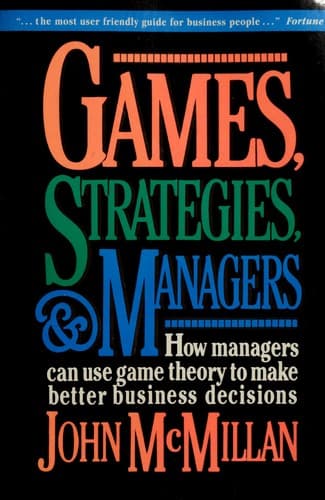
Games, Strategies, and Managers
How Managers Can Use Game Theory to Make Better Business Decisions
Esta parte de readmunity es para lectores con cuenta.
Con una cuenta gratuita puedes guardarlo en tu biblioteca, valorarlo y reseñarlo.
Sinopsis(en Inglés)
No tenemos la sinopsis en tu idioma: se muestra la de la edición original.
"Business is a game--the greatest game in the world if you know how to play it," said IBM's founder Thomas J. Watson. He would probably agree that business negotiations are essentially the game of predicting what the other person will do. Faced with employees, subcontractors, salespeople and others, managers are continually called upon to make strategic decisions based on how someone else will act and react. How do the successful ones do it? Is it savvy? Guesswork? Even the most canny negotiators would be hard-pressed to describe their own methods, which they generally develop intuitively over long and costly experience. But a key to becoming a top negotiator is now available to managers at all levels, in Games, Strategies, and Managers--the revealing new book that injects some science into the art of business decisionmaking . Adapted from the hottest new area of economic theory and based on the latest breakthroughs, Games, Strategies, and Managers goes far beyond the advice commonly offered to negotiators--the old saws, the tales about what worked once in Cleveland--to provide powerful insight into what's really going on beneath every negotiation. Using seven key questions as a starting point, it helps the executive strip away the distracting details of a situation. It doesn't matter if the issue is commissions, piece rates, royalties, managerial incentives, or cost-overrun provisions--the game is the same. The negotiator who recognizes these underlying rules and exploits them to best advantage will gain the upper hand, in formal negotiations as well as in dozens of everyday business situations. Of course, any game involves risk. Managers often have to make a decision without full knowledge of the consequences, and others' actions are not entirely predictable. Game theory explores how to take creative risks to get the strategic edge. Invaluable practical illustrations that show game theory in action include the setting of executives' incentives, the organizing of a network of subcontractors, and a behind-the-scenes look at how international trade negotiations really work. For the sales manager devising a commission-payment scheme to motivate salespeople, the procurement manager trying to get a subcontractor to limit production costs, the compensation committee designing a managerial incentive scheme, and beginning or experienced executives in all industries, Games, Strategies, and Managers shows how to excel at "the greatest game in the world."
Citas
Todavía nadie ha guardado citas de este libro. Añádelo a tu biblioteca y podrás apuntar aquí los pasajes que quieras recordar.
Reseñas
Todavía no hay reseñas de este libro.