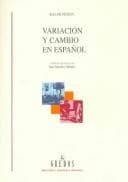
Variación y cambio en español
- 391 páginas
- 2004
- Gredos
- Español
Serie o saga: Biblioteca románica hispánica -- 438
¿Aún no tienes este libro? Elige dónde comprarlo.
Para ayudarte, readmunity te facilita enlaces directos a distintas tiendas. Nosotros no vendemos libros: la compra se hace siempre en la web de cada librería.
Esta parte de readmunity es para lectores con cuenta.
Con una cuenta gratuita puedes guardarlo en tu biblioteca, valorarlo y reseñarlo.
Sinopsis(en Inglés)
Este libro está en español, pero todavía no tenemos su sinopsis en español. Te enseñamos la que hay, en inglés.
This book applies recent theoretical insights to trace the development of Castilian and Latin American Spanish from the Middle Ages onwards, through processes of repeated dialect mixing both within the Iberian Peninsula and in the New World. The author contends that it was this frequent mixing which caused Castilian to evolve more rapidly than other varieties of Hispano-Romance, and which rendered Spanish particularly subject to levelling of its linguistic irregularities and to simplification of its structures. These two processes continued as the language extended into and across the Americas. These processes are viewed in the context of the Hispano-Romance dialect continuum, which includes Galician, Portuguese and Catalan, as well as New World varieties. The book emphasises the subtlety and seamlessness of language variation, both geographical and social, and the impossibility of defining strict boundaries between varieties. Its conclusions will be relevant both to Hispanists and to historical sociolinguists more generally.
Citas
Todavía nadie ha guardado citas de este libro. Añádelo a tu biblioteca y podrás apuntar aquí los pasajes que quieras recordar.
Reseñas
Todavía no hay reseñas de este libro.